
How to Choose Erlenmeyer Shake Flasks for Cell Culture and Bioprocess Labs
Erlenmeyer shake flasks should be selected by working volume, material, cap type, sterility, baffle design, shaking speed, and culture application. For cell culture, microbial fermentation, and process development, the right flask improves aeration, mixing, contamination control, and scale-up consistency.
Shake flasks are used across biotechnology, pharmaceutical research, academic labs, diagnostics, food testing, and industrial microbiology. They look simple, but their design affects oxygen transfer, evaporation, foam behavior, culture growth, and handling efficiency. A poorly matched flask can reduce cell density, create inconsistent batches, or slow down a lab’s workflow.
For buyers and distributors, Erlenmeyer shake flasks are not only glassware or plasticware. They are a recurring consumable linked to cell culture bottles, centrifuge tubes, pipette tips, sterile media handling, and other laboratory supplies. This guide explains how to choose the right flask specification before ordering samples or bulk cartons.
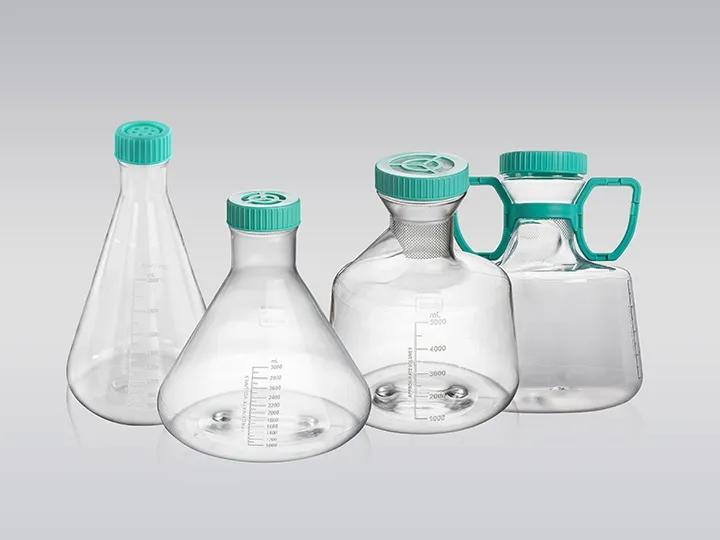
Quick Reference: Shake Flask Buying Checklist
| Factor | What to Check | Why It Matters |
|---|---|---|
| Nominal volume | 125 ml, 250 ml, 500 ml, 1 L, 2 L, or larger | Determines culture scale, headspace, and shaker capacity |
| Working volume | Usually much lower than nominal volume | Controls aeration and mixing efficiency |
| Material | PETG, PC, glass, or other lab-grade material | Affects clarity, breakage risk, sterilization, and cost |
| Cap design | Vented cap, filter cap, plug seal, or closure system | Supports gas exchange while reducing contamination risk |
| Baffle design | Plain bottom or baffled bottom | Changes oxygen transfer and mixing intensity |
| Sterility and packaging | Sterile packed, individually bagged, or bulk packed | Impacts workflow speed, contamination control, and distributor resale |
- What are Erlenmeyer shake flasks used for?
- Which material should laboratories choose?
- Why do cap and venting options matter?
- Plain vs baffled shake flasks: which is better?
- How should buyers choose flask size?
- What should buyers check before bulk ordering?
- FAQ
What Are Erlenmeyer Shake Flasks Used For?
Erlenmeyer shake flasks are used for suspension culture, microbial growth, media preparation, seed culture, fermentation screening, and small-scale bioprocess development. They are especially useful when labs need controlled mixing and gas exchange before moving to larger vessels.
In cell culture workflows, shake flasks support suspension cells and scale-up stages before bioreactors. In microbiology, they are used for bacteria, yeast, and fungi cultivation. In pharmaceutical and biotech research, they help teams test media formulas, growth conditions, and process parameters without committing to large production runs.
Because shake flasks are handled frequently, buyers should think about more than culture performance. Staff need a flask that is easy to grip, clearly graduated, compatible with shaker clamps, and convenient to open under aseptic conditions. Small ergonomic details can matter when a lab processes dozens or hundreds of flasks per week.
Which Material Should Laboratories Choose?
Disposable PETG or PC shake flasks are often preferred for sterile single-use workflows, while glass flasks remain useful for reusable general laboratory work. The best material depends on sterility needs, breakage risk, cleaning capacity, budget, and application sensitivity.
| Material | Typical Use | Buyer Notes |
|---|---|---|
| PETG disposable flask | Cell culture, sterile liquid handling, biotech labs | Good clarity, lightweight handling, and reduced cleaning workload |
| PC disposable flask | Higher strength single-use applications | Check chemical compatibility and sterilization details with the supplier |
| Glass flask | General laboratory mixing and reusable workflows | Reusable but requires washing, sterilization, and breakage control |
Disposable plastic shake flasks can reduce preparation time because they arrive clean and sterile when supplied in suitable packaging. This is valuable for labs with limited washing capacity or strict contamination control. Reusable glass may still be cost-effective for some general applications, but buyers must include labor, cleaning validation, breakage, and storage space in the real cost comparison.
Why Do Cap and Venting Options Matter?
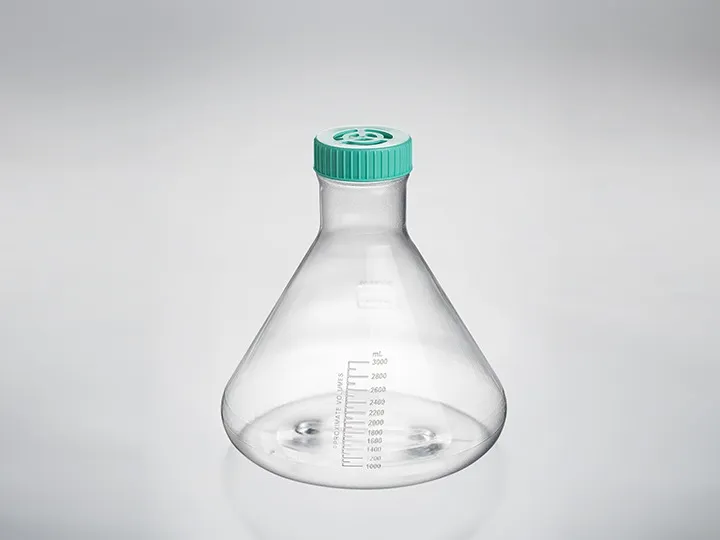
The cap controls gas exchange, contamination protection, and evaporation. For cell culture and microbial growth, buyers should match the cap or vent membrane to the oxygen demand of the culture and the contamination risk of the workflow.
A sealed cap may be useful for transport or temporary storage, but active cultures usually need gas exchange. Vented caps and filter caps allow air movement while reducing particle and microbial entry. The membrane quality, cap fit, and closure consistency all influence culture reliability.
When comparing suppliers, ask whether cap options are available for different applications. A distributor may need to stock both vented and non-vented formats because customer requirements vary. A biotech lab may prefer one cap system across multiple volumes to simplify validation and staff training.
Plain vs Baffled Shake Flasks: Which Is Better?
Baffled shake flasks generally improve mixing and oxygen transfer, while plain-bottom flasks provide gentler culture conditions. Buyers should choose based on organism type, oxygen demand, shear sensitivity, shaking speed, and scale-up requirements.
| Design | Best For | Procurement Advice |
|---|---|---|
| Plain-bottom flask | Gentler mixing, sensitive cells, routine liquid handling | Choose when shear control and simple handling are priorities |
| Baffled flask | Microbial fermentation, higher oxygen transfer, vigorous mixing | Choose when growth depends on stronger aeration and agitation |
| Wide-mouth flask | Easy filling, sampling, and media transfer | Useful for high-throughput labs and frequent manual handling |
Baffles increase turbulence during shaking, which can improve oxygen transfer for many microbial cultures. However, not every sample benefits from stronger turbulence. Some mammalian cell cultures can be sensitive to shear, so buyers should test flask design with their actual culture conditions before switching all volumes.
How Should Buyers Choose Flask Size?
Choose flask size by working volume, shaker platform capacity, oxygen demand, and scale-up plan. The nominal flask volume is not the same as recommended culture volume, so buyers should confirm the intended fill range before ordering.
A 250 ml flask is not meant to be filled to 250 ml for shake culture. Labs usually leave significant headspace for aeration and liquid movement. The right working volume depends on shaking speed, orbital diameter, cell line or organism, media type, and oxygen transfer needs.
For procurement, flask size also affects carton volume, shipping cost, storage space, and shaker utilization. A distributor serving multiple lab types may need mixed sizes, while a single research lab may standardize around two or three volumes to simplify inventory.
What Should Buyers Check Before Bulk Ordering?
Before buying Erlenmeyer shake flasks in bulk, check sample availability, sterility documentation, packaging integrity, cap performance, graduation clarity, material specification, and repeat supply stability. A low unit price is not enough if quality changes between batches.
- Request samples in the exact size, cap type, and packaging format you plan to buy.
- Check whether the flasks are sterile, individually packaged, and clearly labeled.
- Confirm material, working volume guidance, cap membrane type, and carton quantity.
- Test shaker fit, clamp compatibility, cap handling, and graduation readability.
- Ask whether OEM labeling, private label packaging, or distributor cartons are available.
- Confirm whether the supplier can also support related consumables such as pipette tips, centrifuge tubes, cell culture flasks, petri dishes, and disposable gloves.
OBObio supports buyers who need laboratory consumables for research, diagnostics, biotechnology, and distribution. If you are sourcing shake flasks, share your target volume, cap type, sterile requirement, expected monthly quantity, and destination country. This helps the supplier recommend a practical option instead of sending a generic quotation.
FAQ About Erlenmeyer Shake Flasks
What is the difference between an Erlenmeyer flask and a shake flask?
An Erlenmeyer flask is a general conical flask shape. A shake flask is selected or designed for orbital shaking, gas exchange, and culture growth. Many shake flasks use the Erlenmeyer shape, but the cap, material, sterility, and baffle design are application-specific.
Are disposable shake flasks better than glass flasks?
Disposable shake flasks are better for sterile single-use workflows, faster preparation, and reduced cleaning validation. Glass flasks may be suitable for reusable general laboratory work, but they require washing, sterilization, and breakage management.
When should I choose baffled shake flasks?
Choose baffled shake flasks when the culture needs stronger mixing or oxygen transfer, such as many microbial fermentation and screening workflows. For shear-sensitive cultures, test plain and baffled designs before scaling up.
What information should I send for a quotation?
Send the target flask volume, working volume, cap type, sterile requirement, plain or baffled design, packaging preference, order quantity, and destination country. If you need OEM packaging, include label and carton requirements.
Can OBObio supply related cell culture consumables?
Yes. OBObio can support related laboratory consumables such as cell culture flasks, centrifuge tubes, pipette tips, petri dishes, cryogenic vials, and disposable PPE for laboratories and distributors.
Conclusion: Match Shake Flasks to the Culture, Not Just the Catalog Size
The right Erlenmeyer shake flask should match the culture’s oxygen demand, working volume, sterility requirement, cap design, and shaker system. Buyers should test samples and confirm supplier documentation before switching to bulk supply.
For laboratories, good shake flask selection improves consistency. For distributors, stable specifications and reliable packaging make repeat sales easier. Treat shake flasks as part of the full cell culture and bioprocess workflow, and choose a supplier that can support samples, technical details, and recurring orders.
Request Pricing or Samples
Tell us the product type, quantity, destination country, and any packaging or certification requirements. OBObio will reply with suitable lab consumables options.